Satellite Components: Subsystems, Parts and How They Are Machined

Last updated: October 7, 2026
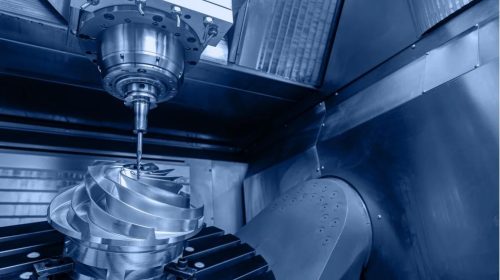
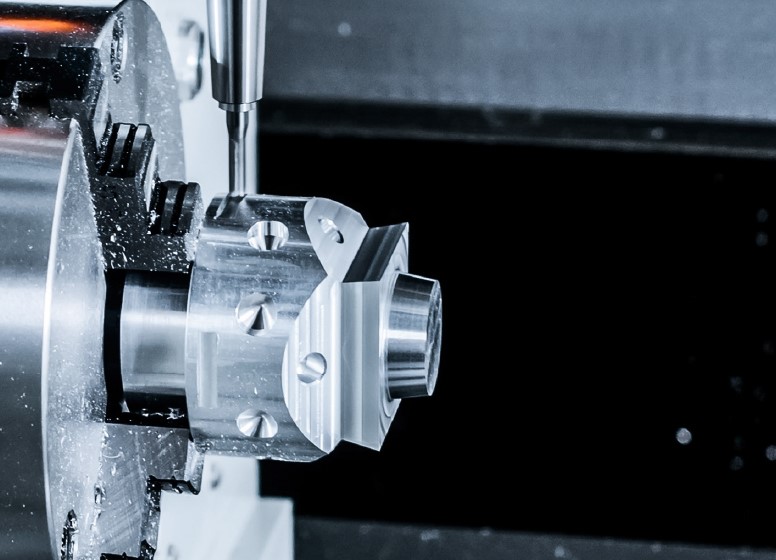
Every satellite has two halves: the bus, or platform, which keeps the spacecraft powered, within its temperature limits and pointed, and the payload, which performs the mission. Satellite components are the subsystems and hardware that make up those two halves, from the primary structure and solar arrays to star trackers, antennas and the on-board computer. A large share of the mass is machined metal (brackets, fittings, housings, waveguides, optical mounts): multi-face parts with tight datum relationships, the typical work of 5-axis aerospace machining. They must also meet requirements aircraft parts rarely see: outgassing limits, cleanliness levels and dimensional stability in orbit.
The main satellite subsystems
CubeSats (built from 10 cm cube units), small satellites of a few hundred kilograms and large geostationary (GEO) communications satellites share the same subsystems. What changes is scale, redundancy and design life.
Structure and mechanisms
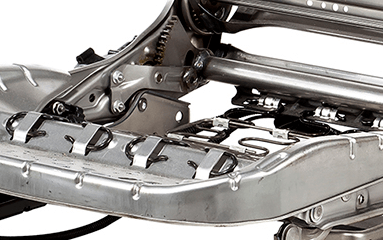
The primary structure carries launch loads and provides the mounting interfaces for every other unit: a central cylinder, a set of panels or a frame, with a launch-adapter ring at its base. Secondary structure covers brackets, equipment platforms and harness supports. Mechanisms include deployment hinges, hold-down and release mechanisms, and drives that rotate solar arrays or point antennas.
Electrical power (EPS)
Solar arrays generate power and batteries, usually lithium-ion, cover eclipses and peak loads. A power conditioning and distribution unit (PCDU) regulates the bus voltage and switches power to each unit.
Thermal control (TCS)
Electronics must stay within their operating range while one side of the spacecraft faces the sun and the other faces deep space. Passive control relies on multi-layer insulation (MLI), radiators, surface coatings and heat pipes; active control adds heaters and thermostats.
Attitude determination and control (ADCS)
Star trackers, sun sensors, gyroscopes and magnetometers measure the spacecraft’s orientation. Reaction wheels, magnetorquers and thrusters change it. Payload pointing accuracy depends on how stably these sensors are mounted to the structure.
Propulsion
Chemical thrusters (monopropellant or bipropellant) or electric propulsion (Hall-effect or gridded ion thrusters) handle orbit raising, station keeping and end-of-life disposal. Small satellites may carry cold-gas systems or no propulsion at all.
Communications and TT&C
Telemetry, tracking and command (TT&C) links carry housekeeping data down and commands up; payload links carry the mission data. The hardware includes antennas, transponders, filters, diplexers and waveguides.
Command and data handling (C&DH)
The on-board computer runs the flight software, stores data and manages the other subsystems over the spacecraft’s data buses.
Payload
Optical imagers and telescopes, RF payloads such as communications transponders or radar, and science instruments. The payload sets most of the requirements the bus is designed around: power, pointing, thermal and data rate.
Which satellite components are CNC machined?
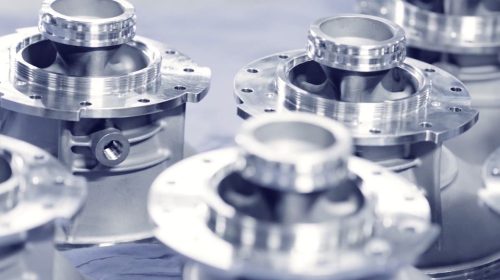
Most machined parts on a satellite are prismatic or pocketed aluminum and titanium parts with features on several faces.
| Subsystem | Machined components | Typical material |
|---|---|---|
| Structure and mechanisms | Brackets, fittings, inserts, edge members of sandwich panels, launch-adapter parts, hinge parts | Aluminum 6061-T6 or 7075-T7351, Ti-6Al-4V |
| ADCS | Star-tracker brackets, reaction-wheel housings, sensor mounts | Aluminum, Ti-6Al-4V, Invar 36 for the most stable mounts |
| Communications | Waveguides, antenna feeds, RF housings | Aluminum 6061-T6 |
| Payload | Optical benches, lens and mirror mounts | Invar 36, Ti-6Al-4V, aluminum |
| Thermal control | Heat-pipe saddles, radiator interface parts | Aluminum 6061-T6 |
| Electronics (EPS, C&DH) | Unit housings, EMI frames, connector brackets | Aluminum 6061-T6 or 7075 |
Electronics housings on a satellite follow the same design rules as RF and avionics enclosures on aircraft (thin walls, EMI flanges, connector cut-outs, flat mating faces), with a tighter mass budget. EMI shielding frames are a typical example.
Machining satellite hardware? Send your drawing and requirements. Request a Quote
Materials for machined satellite components
- Aluminum 6061-T6 and 7075-T7351. Most structure and housings. 6061-T6 machines well and takes chem film and anodize; 7075 is chosen where a bracket or fitting needs more strength.
- Ti-6Al-4V. Fittings and inserts, especially where they bond or bolt to carbon-fiber (CFRP) panels: titanium is galvanically compatible with carbon fiber and its thermal expansion is much closer to CFRP than aluminum’s. See titanium aerospace parts.
- Invar 36. Optical benches and instrument mounts where dimensional stability over temperature matters most; its thermal expansion is roughly a tenth of that of ordinary steels. It is gummy to machine and needs stress relief between roughing and finishing.
- Stainless steels 17-4PH and A286. Mechanisms, shafts, pins and fasteners where strength and wear resistance count more than mass.
- PEEK and Vespel. Insulating washers, thermal isolators and bushings, in grades screened for low outgassing. See machined PEEK parts.
For a deeper look at these materials, read machining Invar, titanium and PEEK for space.
Space-specific requirements for machined parts
The customer defines these requirements on the drawing, the purchase order or the program’s materials and process list. The machine shop executes them and documents what it did.
- Outgassing. In vacuum, volatile compounds escape from materials and can condense on cold optics, sensors and solar cells. Materials, adhesives and coatings are screened to ASTM E595, which measures total mass loss (TML, typically limited to 1.0%) and collected volatile condensable materials (CVCM, typically 0.10%). The test is run on the material by the customer or a test lab; the machine shop buys the qualified grade and supplies material certificates on request.
- Cleanliness. Where the contract specifies it, particulate and molecular cleanliness levels per IEST-STD-CC1246 define how parts are cleaned, handled and bagged after machining. Cutting fluids, marking inks and packaging are chosen so they leave no residue the cleaning step cannot remove.
- Dimensional stability. Parts must keep their geometry through launch vibration and thermal cycling in orbit. Stress relief after roughing, balanced material removal and light finishing passes limit the residual stress that would otherwise relax later and move a sensor or optical mount out of alignment.
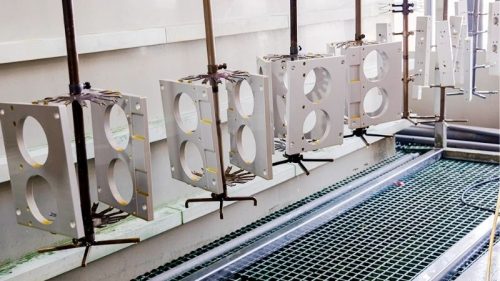
- Surface finishes. Chem film to MIL-DTL-5541 Class 3 where low electrical contact resistance is needed for bonding and grounding; black anodize to MIL-A-8625 Type II, Class 2 for thermal emissivity or stray-light control. Each finish is screened for outgassing like any other material.
- Materials and process controls. NASA-STD-6016 is NASA’s reference for materials and processes requirements on spacecraft, and most programs flow down an approved list based on it or on an equivalent agency standard. The assembled hardware is later tested to vibration and environmental levels such as those of GSFC-STD-7000 (GEVS), so machined interfaces must hold their preload and alignment through those tests.
Lightweighting satellite structures with 5-axis machining
Launch mass drives the whole design, so machined structures are pocketed to remove material while keeping stiffness:
- Isogrid and orthogrid panels. Triangular or rectangular rib patterns machined from plate, leaving a thin skin and ribs that carry the load.
- Thin walls. Housings and brackets with thin walls, held to size by the machining sequence and by fixtures that support the wall during finishing.
- Integral brackets. A bracket machined as part of a panel or frame removes fasteners, interfaces and their tolerance stack.
Five-axis machines reach ribs, deep pockets and angled interfaces in one setup with short tools, which keeps walls straight and interfaces true to the same datums. Toolpaths, fixturing and wall support for these parts are discussed further in 5-axis strategies for lightweight satellite structures.
Machining satellite parts with AeroCNCParts
AeroCNCParts, a machining division of DEK, machines non-engine aerospace parts to the customer’s drawing, from first article through low-volume and repeat batches. For space-equipment companies in stable production, that means parts such as brackets, housings, EMI frames and antenna parts, machined to the material grades, cleaning and documentation requirements called out on the drawing.
Each batch is CMM inspected and traced by heat / lot. Material certificates, a Certificate of Conformance and an AS9102-style FAI report on the first article are supplied on request. More on our quality assurance and inspection. Development models and test hardware for early-stage prototypes and design iteration go to our sister site, AeroRapidProto.
Request a quote for machined satellite parts
Upload your drawing and 3D model, with the material spec, finish, quantity and the space-specific requirements that apply (cleaning, packaging, documentation). NDA available on request.
FAQ
What are the main components of a satellite?
The bus, which includes the structure, power, thermal control, attitude control, propulsion, communications and data handling subsystems, and the payload that performs the mission.
Which satellite parts are CNC machined?
Brackets, fittings, housings, waveguides, antenna parts, optical mounts and structural panels are commonly machined, mostly from aluminum, titanium and Invar.
Why does outgassing matter for satellite materials?
In vacuum, volatile content escapes from materials and can condense on optics and sensors. Materials and coatings are therefore screened to ASTM E595 limits before they are approved for flight hardware.
Can AeroCNCParts machine space-grade parts?
We machine aerospace parts to your drawing and to the space-specific requirements you specify, such as material grade, cleaning and documentation.

Kim
Kim oversees engineering operations, including complex process planning, DFM reviews, and solving challenges associated with high-precision aerospace parts. He specializes in strict tolerance control and machining complex geometries essential for avionics, turbine components, and structural frames. Outside of work, he enjoys the precision and strategy of playing snooker.