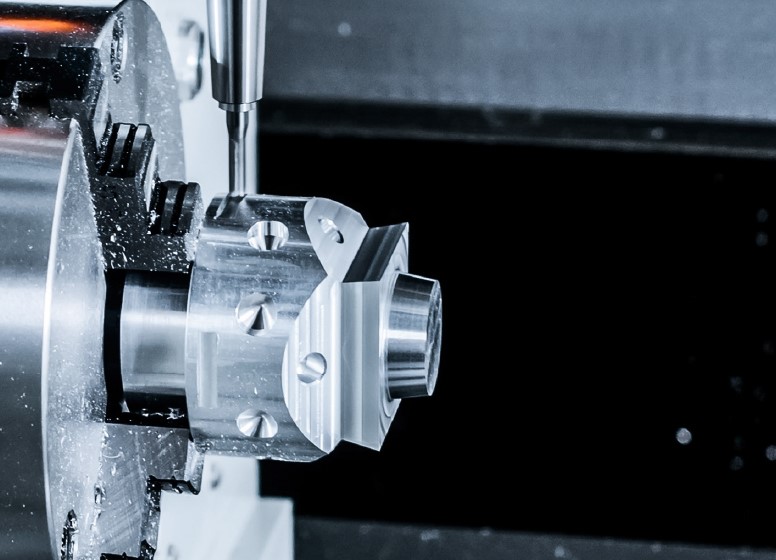
Anodizing Types for Aerospace Parts Compared: Pros, Cons and Alternatives
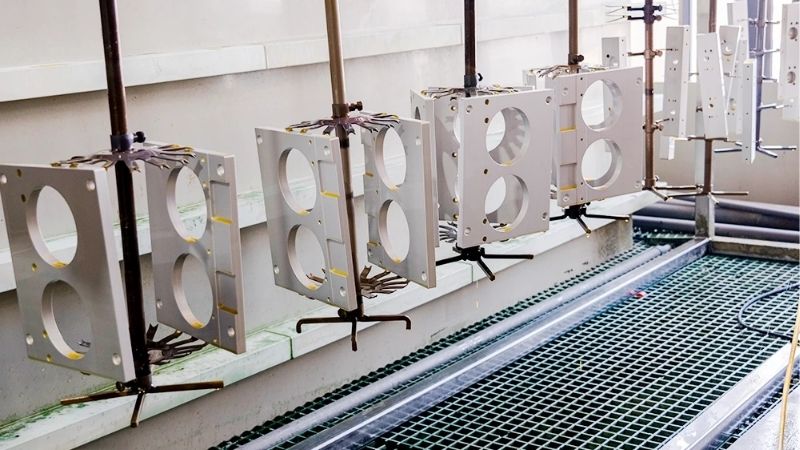
Last updated: October 7, 2026
On a machined aerospace part, the anodize callout is not a cosmetic detail. The type and thickness decide how much each surface grows, how much fatigue strength the part gives up, whether a contact face still conducts, and how well the aluminum resists corrosion. Choosing between MIL-A-8625 types, or choosing chem film or another finish instead, is a design decision with consequences at inspection. For parts machined and finished to your callout, see our aerospace anodizing services.
How anodizing works
Anodizing makes the aluminum part the anode in an acid electrolyte. Current passes through the bath and converts the surface of the metal into aluminum oxide. The layer is grown from the substrate itself, so it does not flake or peel the way paint or plating can.
The oxide forms as a dense barrier layer next to the metal, topped by a porous layer of fine, regular cells. Those pores take dyes, primers and adhesives. Sealing (in hot deionized water, sodium dichromate or nickel acetate) then hydrates the oxide and closes the pores to improve corrosion resistance.
Because the oxide replaces metal while it grows, part of the coating penetrates below the original surface and part builds up above it. For hard coat, the split is roughly half and half. For thinner sulfuric films, less than half builds up. This is why anodize changes dimensions and why the drawing must say whether dimensions apply before or after coating.
MIL-A-8625 anodizing types compared
Thickness values are typical; the specification and the drawing set the actual callout.
| Type | Electrolyte | Typical thickness | Pros | Cons | Typical aerospace use |
|---|---|---|---|---|---|
| Type I / IB | Chromic acid | 0.5 to 7.6 µm (0.00002 to 0.0003 in) | Very thin; minimal fatigue debit; good paint and bond base | Hexavalent chromium restrictions; little wear resistance | Fatigue-sensitive structure, painted or bonded assemblies |
| Type IC | Non-chromic acid | Thin film, similar to Type I | Replaces chromic acid without hexavalent chromium | Thin; limited wear resistance | Chromic acid replacement on structure |
| Type II | Sulfuric acid | 5 to 25 µm (0.0002 to 0.001 in) | Dyeable; good general corrosion protection; widely available | Larger fatigue debit than thin films; insulating | Brackets, housings, visible cabin parts, color coding |
| Type IIB | Thin sulfuric acid | Thin film, similar to Type I | Non-chromate replacement for Type I; small fatigue debit | Thin; limited wear resistance | Structure where chromic acid is being phased out |
| Type III | Sulfuric acid (hard coat) | 51 µm (0.002 in) nominal unless specified | High wear and abrasion resistance | Largest growth and fatigue debit; brittle on sharp edges | Sliding faces, hinge bores, guide surfaces |
Each type is ordered in Class 1 (undyed) or Class 2 (dyed). Aerospace drawings often add an AMS process specification: AMS 2470 (chromic acid), AMS 2471 (sulfuric acid, undyed), AMS 2472 (sulfuric acid, dyed) or AMS 2469 (hard anodic coating).
Need parts machined and anodized to MIL-A-8625? Request a quote.
Anodizing vs chem film (MIL-DTL-5541) and other alternatives
| Finish | Specification | Choose it when | Watch-outs |
|---|---|---|---|
| Chem film | MIL-DTL-5541, Type I (hexavalent) or Type II (trivalent); Class 1A or Class 3 | Class 3: a face must stay electrically conductive. Class 1A: maximum corrosion protection or a paint base, with almost no dimensional change | Thin and soft; no wear resistance |
| Passivation | AMS 2700 | Stainless steel parts need restored corrosion resistance | Adds no thickness or hardness; not for aluminum |
| Electroless nickel | AMS 2404 | Complex parts need a uniform wear and corrosion layer, including inside bores | Specify thickness and any bake on high-strength substrates |
| Shot peening | AMS 2430 | A fatigue-sensitive part needs compressive surface stress, often before anodizing | A treatment, not a corrosion finish |
| Paint and primer systems | Per the design authority | Exterior corrosion protection over chem film or thin anodize | Adds thickness; needs a good pretreatment |
Chem film and anodize are often combined on one aluminum part: chromate conversion coating on grounding and bonding faces, anodize everywhere else. Stainless parts go to passivation for stainless parts, and fatigue-critical aluminum parts can receive shot peening before anodizing. We supply Type II and Type III anodizing, chem film, passivation, electroless nickel and shot peening on the parts we machine.
Advantages of anodizing aerospace aluminum
- Corrosion resistance. The oxide replaces aluminum’s thin natural film with a much thicker barrier, and sealing improves it further. It matters most on 2xxx and 7xxx alloys, which are strong but corrode readily.
- Wear resistance. Type III hard coat protects sliding, bearing and frequently handled surfaces.
- Paint and adhesive adhesion. The porous layer gives primers and structural adhesives a surface to key into, which is why thin films sit under paint and bonded joints.
- Electrical insulation. The oxide does not conduct, which helps where parts must be isolated.
- Identification. Class 2 dyes allow color coding and a uniform appearance on cabin and avionics parts.
- Integral layer. The coating is converted metal, so it does not flake off like paint.
What are the downsides of anodized aluminum?
- Fatigue strength reduction. Thick sulfuric and hard coats can lower fatigue life, and the effect can be significant on high-strength alloys. Check your design allowables; thin chromic or Type IIB films carry a smaller debit.
- Dimensional growth. Every coated surface moves. A Type III coat closes a bore and grows a shaft by about its full thickness on the diameter.
- Brittle edges and crazing. Hard coat chips on sharp corners and can craze with heat or bending after coating. Radius the edges and finish all machining before anodizing.
- Insulation where grounding is needed. Bonding points and EMI contact faces must be masked or chem-filmed.
- Alloy-dependent results. 2024 and other high-copper alloys give thinner, softer coats and can burn under hard-coat conditions. Silicon-rich castings anodize poorly.
- Color matching. Dyed shades vary between alloys and between lots.
- Environmental constraints. Chromic acid processes use hexavalent chromium, which REACH and similar rules restrict.
- Masking and rework. Masking adds labor, and stripping and re-anodizing removes metal, so a rejected coating on a tight-tolerance part can mean scrap.
How these trade-offs play out by alloy is part of the 7075-T6 vs 2024-T3 choice.
What is the 720 rule for anodizing?
The 720 rule is a rule of thumb for sulfuric acid anodizing: about 720 ampere-minutes per square foot build roughly 1 mil (0.001 in, about 25 µm) of coating. Written as a formula:
Time (min) ≈ 720 × thickness (mils) ÷ current density (A/ft²)
Worked example: a 0.5 mil (about 13 µm) Type II coating at 12 A/ft² takes 720 × 0.5 ÷ 12 = 30 minutes.
The rule has limits. It is a Type II estimate at conventional bath conditions; it does not apply as-is to hard coat, which runs colder and at different current densities; and alloy, temperature and electrolyte concentration all move the result. In production, the process specification and the processor’s qualified parameters govern, and thickness is verified by measurement.
What metals cannot be anodized?
Conventional anodizing works on aluminum, titanium and magnesium, plus niobium, tantalum and zinc in niche uses. Titanium and magnesium anodizing are separate processes with their own specifications and purposes.
Carbon steel, stainless steel, copper, brass and nickel alloys such as Inconel do not form a protective anodic oxide. They take other finishes: passivation for stainless steel, electroless nickel or other plating for steels and copper alloys, and conversion coatings where the drawing calls for them.
What drives the cost of anodizing a machined part?
There is no useful price per part without the drawing, but the drivers are predictable:
- Type and thickness. Hard coat runs in cooled tanks with longer cycles than Type II.
- Masking. Each masked thread, bore or contact face adds preparation and inspection.
- Batch size and racking. Every lot has setup and racking time, so small batches cost more per part.
- Alloy. High-copper alloys need tighter control.
- Class, color and seal. Dyed and sealed coatings add steps.
- Thickness range on fit features. A narrow range needs closer control and measurement.
- Documentation and tests. Seal tests, salt-spray tests and extra records add cost when the specification or purchase order requires them.
How to specify anodizing on a drawing
A complete callout answers eight questions: specification, type, class, thickness (with tolerance), seal, color, masking, and whether dimensions apply before or after finish.
Example callout, for illustration only:
ANODIZE PER MIL-A-8625, TYPE III, CLASS 1, 0.002 IN THICK, UNSEALED, MASK PER ZONE A. DIMENSIONS APPLY AFTER ANODIZE.
List the alloy and temper as well. The aerospace aluminum alloys you choose decide how the coating looks and behaves, and a finisher cannot correct that afterward. The broader rules on roughness and finish callouts are in aerospace surface finishing requirements.
Request a quote for machined and anodized parts
Upload your drawing and 3D model, with the anodize specification, type, class, thickness, seal and masking, the alloy and temper, quantity and required documentation (material certs, FAI, CoC). NDA available on request.
FAQ
Is Type III anodizing the same as hard anodizing?
Yes. Type III in MIL-A-8625 is the hard coat, typically much thicker than Type II and chosen for wear and abrasion resistance.
Does anodizing change part dimensions?
Yes. Part of the coating builds up above the original surface (about half for hard coat), so tight bores, threads and mating faces need an allowance or masking.
Can anodized parts be electrically grounded?
Not through the coating, which is insulating. Grounding points are masked or chem-filmed instead.
Is aerospace-grade aluminum good for anodizing?
6061 anodizes very well and 7075 is good. 2024 and other high-copper alloys give thinner, softer coats and need tighter process control.

Kim
Kim oversees engineering operations, including complex process planning, DFM reviews, and solving challenges associated with high-precision aerospace parts. He specializes in strict tolerance control and machining complex geometries essential for avionics, turbine components, and structural frames. Outside of work, he enjoys the precision and strategy of playing snooker.