Aerospace Anodizing, Type II and Type III
Aerospace anodizing grows an aluminum oxide layer out of the part itself instead of depositing a coating. We deliver machined aluminum parts with Type II or Type III per MIL-A-8625.

Aerospace anodizing grows an aluminum oxide layer out of the part itself instead of depositing a coating. We deliver machined aluminum parts with Type II or Type III per MIL-A-8625.
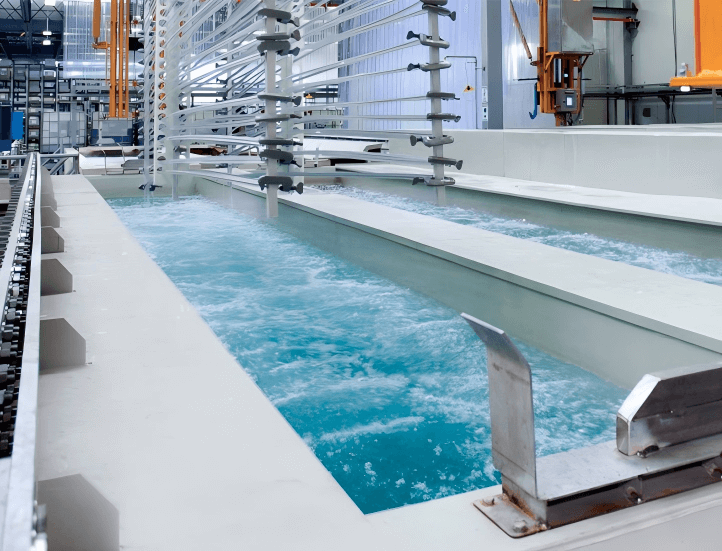
An electrochemical process grows an oxide layer out of the aluminum to protect it against corrosion, add wear resistance, key primers and adhesives, and insulate electrically. MIL-A-8625 defines Type II and Type III, each in Class 1 (undyed) or Class 2 (dyed).
AeroCNCParts, a machining division of DEK, machines aerospace aluminum parts to your drawing and delivers them anodized to its callout. Many drawings also cite an AMS process specification.
About half of a hard coat builds up above the machined surface and half penetrates below. A 51 µm coat moves each surface out by roughly 25 µm: shafts grow and bores close.

State on the drawing whether each critical dimension applies before or after anodize, before machining starts.

Machine bores oversize and shafts undersize by the growth: Type II often about one third, Type III about half.

The oxide insulates: grounding points, EMI gasket faces, bearing bores, press fits and threads are masked and named on the drawing.

Hard coat leaves a chip-prone zone on sharp corners; as a guideline, radius external edges 0.5 mm (0.020 in) or more.

Each part needs an electrical contact point on the rack, which stays bare. Show where a small rack mark is acceptable.

Thick coats can lower fatigue strength. The design authority chooses a thinner coat, chem film or shot peening before anodizing.
Specification
MIL-A-8625 Type III; AMS 2469 where cited (set by the drawing)
Thickness
51 µm (0.002 in) nominal unless specified (set by the drawing)
Build-up
About half of the thickness per surface (process behavior)
Class
Class 1 (undyed) or Class 2 (dyed) (set by the drawing)
Seal
Unsealed for maximum wear, sealed for corrosion (set by the drawing)
Masking
Threads, bores, grounding points, datum faces (masking drawing or zones)
Records
CoC with spec, type and class; thickness record; on request (set by the purchase order)

Most uniform coating and color; common on housings.
Type II: Excellent, Type III: Excellent
Harder to dye evenly; shade can vary between lots.
Type II: Good, Type III: Good
Thick-plate structural parts; behaves much like 7075.
Type II: Good, Type III: Good
Thinner, softer hard coat; risk of burning; tighter control.
Type II: Fair, Type III: Limited
Darker, less uniform coating; feasibility checked at quote.
Type II: Limited, Type III: Limited
ISO 9001-certified quality system

General corrosion protection and color on structural parts, brackets and housings.
MIL-A-8625
Chromate conversion coating for conductive faces (grounding, EMI) or a thin paint base.
MIL-DTL-5541

Uniform wear and corrosion protection on complex precision parts.
AMS 2404| Type | Electrolyte | Typical thickness | Typical aerospace use |
|---|---|---|---|
| Type II | Sulfuric acid | 5 to 25 µm (0.0002 to 0.001 in) | Corrosion protection on brackets and housings; dyed black on avionics and cabin parts |
| Type III (hard coat) | Sulfuric acid, low bath temperature, higher current density | 51 µm (0.002 in) nominal unless the drawing specifies otherwise | Wear resistance on sliding faces, hinge bores, guide surfaces, handled parts |
Answers on anodize rules of thumb, limits, metals, cost and how to specify Type II or Type III on your drawing.
Send your drawing and 3D model for a quote: an engineer reviews it before machining, NDAs are signed on request, and repeat batches follow the same inspection plan.

Full material traceability, 100% inspection, AS9100-ready process