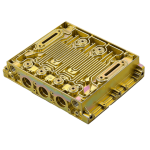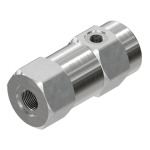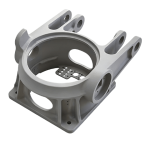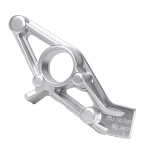
Micro Arc Oxidation for Aerospace Components

An advanced electrochemical coating method that converts light metal surfaces into dense ceramic layers, enhancing hardness, corrosion resistance, and thermal resistance in critical aerospace environments.
What it is

Micro Arc Oxidation Treatment for High-Performance Aerospace CNC Parts

Micro Arc Oxidation (MAO) uses controlled plasma discharges to create a durable ceramic oxide layer on aluminum, titanium, and magnesium alloys. We apply this NADCAP-approved process to deliver exceptional surface strength, wear protection, and precision for aerospace parts built to AS9100D standards.

  • Dimensional Note:

    Coating thickness generally ranges between 10–150 µm, maintaining strict tolerance accuracy of ±0.005 mm for precision aerospace assemblies.

Benefits

Why Choose Our MAO Service?

Exceptional Corrosion Defense

Creates a compact, ceramic barrier that prevents oxidation and moisture intrusion.

High Thermal Stability

Endures high temperatures, ensuring reliability in propulsion and exhaust systems.

Extreme Surface Hardness

Increases hardness values up to 2000 HV for load-bearing components.

Electrical Insulation

Provides dielectric protection for connectors and avionics enclosures.

Dimensional Consistency

Delivers uniform coatings while preserving exact part geometry.

Strong Adhesion

Forms within the substrate, preventing flaking or delamination.

Technical Specs

MAO Service Specs

Coating Thickness

Typically 10–150 µm, depending on discharge control.

Hardness

Reaches up to 2000 HV for enhanced wear life.

Thermal Resistance

Maintains stability beyond 600°C.

Dielectric Strength

Excellent electrical insulation properties.

Adhesion

Integral bonding prevents coating separation.

Standards

Certified to AS9100D and ISO 9001 standards, FAI, and ITAR registered.

Case

Typical Aerospace Parts Cases

  • Magnesium Gearbox Housings

    Complex milling ensuring superior corrosion resistance and thermal stability.

    Magnesium AZ91D, WE43
  • Hydraulic Cylinder Sleeves

    Deep bore machining creating ceramic-like hardness for sliding wear.

    Aluminum 7075-T6, 2024-T3
  • UAV Optical Gimbals

    Lightweight turning requiring high stiffness and anti-glare matte finish.

    Magnesium AZ31B, Aluminum 6061-T6
Case

Compare Before and After MAO

Before
After
Quality & Compliance

Quality Assurance and Process Traceability

  • AS9102 FAI compliant for precise coating build-up and dimensional tolerance control.
  • Certified test reports for Dielectric Breakdown Voltage, Salt Spray, & Surface Roughness (Ra).
  • 100% traceability via Lot ID, Racking Maps, & Real-time Process Parameter Logging.
AS9100D

Aerospace-aligned quality system

ISO 9001

Documented and auditable processes

Applications

Typical Applications for Aerospace MAO

Engine and Turbine Housings

Improves oxidation and heat resistance during high-temperature operations.

Extreme Thermal Stability

Aerospace Brackets and Fasteners

Provides superior wear protection under repeated load cycles.

Superior Load Durability

Landing Gear and Actuation Systems

Prevents corrosion damage from fluid exposure and humidity.

Fluid Corrosion Prevention

Electronic Casings and Connectors

Offers insulation and dimensional reliability for precision assemblies.

Dimensional Reliability
Compare Finishes

Choosing the Right MAO for Your Parts

MAO Type Purpose Coating Density Thermal Resistance Hardness Notes
Standard MAO General coating for aerospace alloys High Excellent 1600–1800 HV Used for structural parts
Pulse-Controlled MAO Improves discharge uniformity on intricate shapes. Very High Excellent 1800–2000 HV Ideal for thin walls.
Hybrid MAO Combines anodic and plasma oxidation for density. Highest Excellent Up to 2000 HV Suitable for housing.
FAQ

Micro Arc Oxidation Common Questions

Common Questions on Micro Arc Oxidation for Precision Parts

Which materials are ideal for MAO?
Aluminum, titanium, and magnesium alloys respond best, improving mechanical durability and corrosion performance.
Does MAO change part dimensions?
No. Coating growth is controlled, ensuring the required tolerances and precision are maintained.
How is MAO different from anodizing?
MAO generates plasma micro-discharges that produce denser, harder coatings.
Is the MAO coating conductive?
No. The layer is non-conductive, ideal for electrical insulation.
Do you provide aerospace-grade MAO finishing?
Yes. We offer AS9100D and NADCAP-compliant MAO services, providing full traceability and comprehensive inspection documentation.